

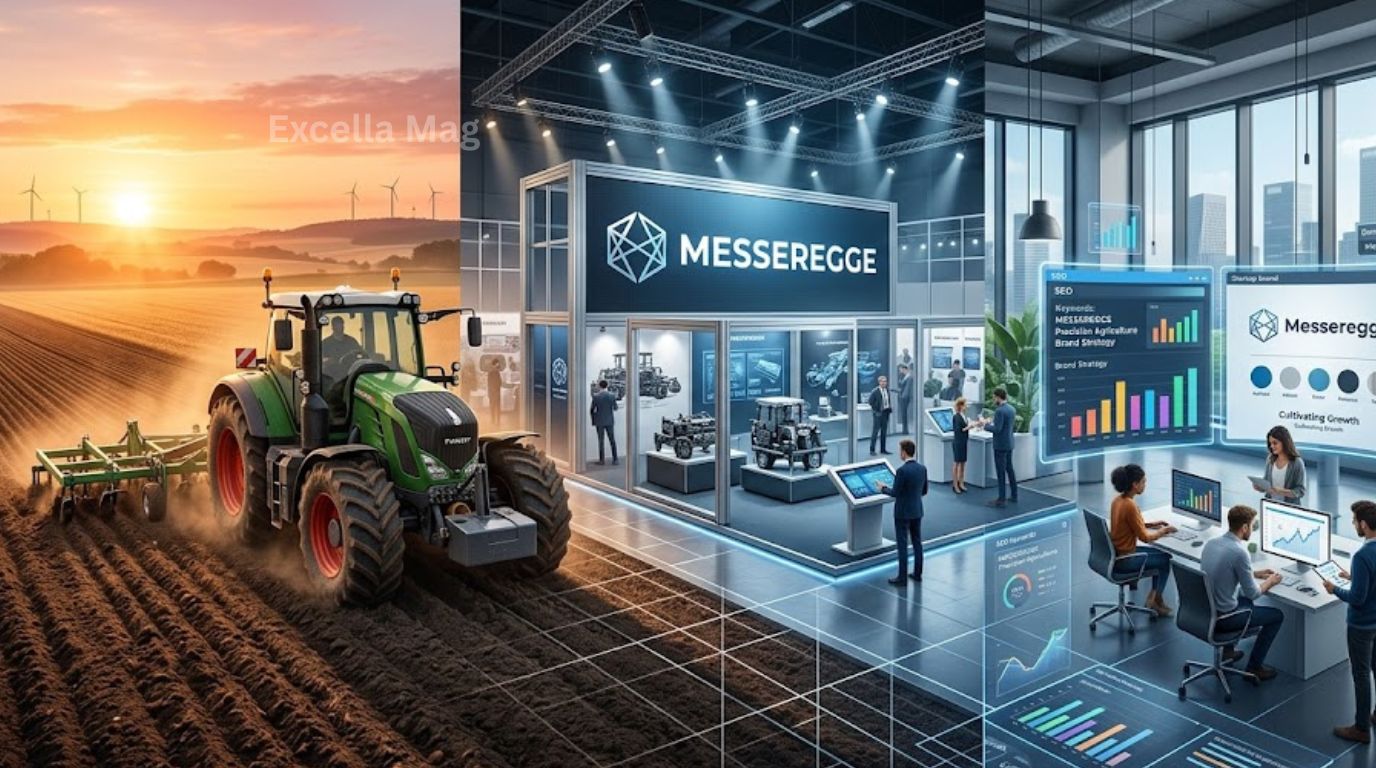
Some words live quietly in specialist manuals for decades — technical, precise, unglamorous — and then some words suddenly break out of their niche and start showing up in places no one expected. Messeregge is exactly that kind of word. If you came across it in a farming catalogue, a trade show brief, or a startup pitch deck and thought, “Wait, is this the same thing?” — you’re not alone, and you’re not confused. You’re just encountering one of the more fascinating examples of how a single term can carry genuine meaning across wildly different industries.
What makes Messeregge genuinely interesting isn’t its novelty or mystery — it’s actually the logic behind why the same compound word shows up in a German farmer’s field, a European exhibition hall, and an SEO-savvy startup’s brand strategy. That logic, once you understand it, is surprisingly coherent. This article unpacks everything: the word’s true origins, how it functions in each of its three contexts, and why it matters in 2026 more than it ever did before.
Where It All Begins: The Etymology and Origins of Messeregge
To understand Messeregge, you have to start with the German language, which has always had a talent for building long, precise compound words that do the work of entire sentences. The word breaks cleanly into two parts: Messer, meaning knife or blade, and Egge, meaning harrow — a traditional farming implement used to break and level soil. Put them together and you get a “knife harrow,” a blade-equipped agricultural tool designed for shallow, precise soil cultivation.
This isn’t recent coinage. One of the earliest documented references to “Messereggen” as a described tool category appears in early 20th-century German agricultural patent records, with an 1919 German patent specifically referencing the design of knife harrow tillage equipment. These tools were essential in German-speaking farming communities — rural Austria, Switzerland, and Germany — where soil diversity demanded implements that could be precise without being destructive. The blade harrow, unlike a plow, doesn’t turn the soil over entirely. It skims, cuts, aerates, and levels the upper layers, making it ideal for preparing a seedbed between growing seasons.
What’s particularly revealing about the etymology is that both root words — Messer and Egge — have layered meanings. Messer doesn’t just mean knife; it also implies measurement and cutting precision. Egge doesn’t just mean harrow; it also relates to edge or ridge in certain dialects. That dual meaning in both components is what gave the compound word enough flexibility to migrate into other domains. A term built on “precision cutting” and “structured edging” was always going to find a second life somewhere.
Messeregge in Agriculture: Precision Soil Science That Still Matters Today
In its original and most technically grounded context, the Messeregge is a piece of farm equipment — specifically a blade harrow used for seedbed preparation. It works by passing a row of knife-like blades across the top five to ten centimeters of soil, breaking up surface crusts, slicing through residual organic matter, and creating a fine, even tilth that gives seeds optimal germination conditions.
Unlike deep tillage implements that invert entire soil profiles, the Messeregge operates with what modern agronomists call “minimal disturbance” philosophy. It preserves the natural soil structure beneath the tillage layer while refining what’s on top. This matters enormously in the context of precision agriculture, a growing global approach that uses data, targeted equipment, and conservative practices to maximize yield while minimizing environmental impact.
Modern agricultural manufacturers in German-speaking Europe — including companies like Kerner — have incorporated Messeregge elements into combination implements like front packers. A Frontpacker mit Messeregge pairs a roller system with the blade harrow function, consolidating soil while simultaneously creating fine seedbed conditions in a single pass. This kind of integration reduces the number of times a tractor needs to cross a field, cutting fuel consumption and soil compaction. For farmers working with tight seasonal windows, this efficiency isn’t a luxury — it’s critical.
The tool also plays a role in weed suppression. Because the blades cut through shallow soil at specific depths, they disrupt early-stage weed germination without burying weed seeds deeper where they might survive. This complements integrated pest management strategies and reduces herbicide dependency, which aligns with the EU’s Farm to Fork strategy pushing European agriculture toward more sustainable input practices by 2030.
What competitors writing about Messeregge often miss is this sustainability dimension. The tool isn’t just efficient — it’s environmentally sensible in a way that matters to the current generation of farmers navigating subsidy requirements, carbon accounting, and soil health mandates. The Messeregge, properly understood, is not old-fashioned technology. It’s a precision tool that fits naturally within the vocabulary of regenerative and conservation agriculture.
Messeregge in Exhibition Design: Where Structure Becomes Strategy
The second context where Messeregge appears is the world of trade fairs, expos, and exhibition design. Here, the word describes something entirely different in application but surprisingly similar in principle: the structural edge and framing systems that define the boundaries and skeleton of a trade show booth.
If you’ve walked through a major trade fair — whether at Messe Frankfurt, Messe München, or any international expo — you’ve been surrounded by Messeregge systems without knowing the term. Those clean aluminum profiles running along booth perimeters, the channel systems holding large-format graphics taut and flat, the modular frames that allow exhibitors to configure their stand differently for every show — these are the physical embodiment of what exhibition professionals refer to as Messeregge.
The reason the same word migrated here is structural (pun intended). Just as the agricultural Messeregge creates precise edges in soil, the exhibition Messeregge creates precise edges in space. It defines where one exhibitor’s world ends and another’s begins. It holds visual content at the exact angles and heights that attract attendee attention. And it does all of this while remaining, ideally, invisible — because good exhibition framing doesn’t draw attention to itself.
This has become increasingly important as trade show competition intensifies. According to UFI, the Global Association of the Exhibition Industry, the global exhibition market has been recovering strongly through 2025-2026 after pandemic disruption, with exhibitor competition for attendee attention at record levels. In that environment, the physical structure of your booth — how it edges, frames, and delineates your brand space — is not a logistical afterthought. It’s a strategic communication tool.
Good Messeregge design in exhibition contexts also enables modularity. Brands that exhibit multiple times per year across different venues need framing systems they can reconfigure, transport efficiently, and reassemble quickly. Modular edge systems made from lightweight aluminum profiles can be broken down, packed, and rebuilt by small teams. This reduces event production costs significantly over time and allows a consistent brand presentation even when floor space dimensions change between venues.
Messeregge in Digital Branding: A Word Searching for Its Product
The third dimension of Messeregge is the most recent and, frankly, the most speculative — though it’s also perhaps the most interesting from a linguistic and brand strategy perspective. In the past two years, “Messeregge” has started appearing in digital marketing discussions, SEO analyses, and startup naming conversations as a potential brand identity.
No verified digital platform or product currently operates under the Messeregge name. That’s an important clarification that most competitor articles either bury or skip entirely. The digital branding conversation around Messeregge is aspirational and theoretical, not factual. Some bloggers and brand strategists have pointed to it as an example of a distinctive, low-competition keyword with high brand potential — a name that sounds European, technical, and authoritative without being immediately understood, which in certain markets is actually a feature rather than a bug.
It’s worth noting why this kind of thing happens. In the age of domain-driven branding, startup founders and brand consultants regularly search for unused words that have enough phonetic appeal and SEO vacuum to serve as a brand name. Messeregge checks several boxes: it’s distinctive, it has a traceable etymology (which lends credibility), it sounds professional in both English and German contexts, and it hasn’t been claimed as a major brand identity. The comparison to companies like Slack, Discord, or Klarna — all of which used invented or obscure words — isn’t entirely misplaced as a strategic model.
However, the gap between “this word would make a good brand name” and “this word is a brand name” is where Messeregge currently sits. For anyone evaluating it as a digital tool or platform, the honest assessment is that no such product exists yet. If you’re searching for a “Messeregge messaging app” or a “Messeregge communication platform,” you’re chasing a concept, not a product. That said, the word’s growing presence in search indexes suggests that if and when a digital product does claim this identity, it will enter a niche with existing search recognition and a surprisingly clean semantic foundation.
The Common Thread: Why One Word Works in Three Worlds
At this point it’s worth stepping back and asking: why does one compound word, rooted in 19th-century German agricultural engineering, make sense in exhibition design and in digital brand strategy? The answer lies in what both root words actually mean at a conceptual level.
Precision and edge. That’s the core of Messeregge in every context. In the field, it’s about cutting the soil at the exact right depth to create conditions for growth. In exhibition halls, it’s about defining the edge of a brand’s physical presence to create conditions for engagement. In digital branding, it’s about finding the precise linguistic edge that separates one identity from the noise of a saturated naming market.
There’s a useful design principle here that transcends any single industry: the best systems don’t just occupy space — they define it. A knife harrow doesn’t plow randomly; it cuts deliberately. A booth frame doesn’t just hold things up; it shapes a visitor’s visual experience. A brand name doesn’t just exist; it cuts through cognitive clutter. Messeregge, in all three contexts, is fundamentally about the act of defining boundaries in order to create clarity.
Understanding this shared logic also helps anyone working across these fields. Farmers thinking about soil preparation can borrow the precision-system mindset that exhibition designers use. Exhibition designers can think about their framing choices the way farmers think about minimum disturbance — what’s the least structure needed to achieve the maximum result? And digital brand builders can learn from both: build something that cuts clearly, defines boundaries sharply, and leaves the surrounding space undisturbed.
What Competitors Got Wrong (And What You Should Know Instead)
Most articles currently ranking for Messeregge make a few consistent mistakes worth addressing. Several treat the “digital platform” angle as if it were real and established, which misleads readers genuinely searching for such a product. Others describe the agricultural application so superficially that they miss its connection to modern precision farming and EU sustainability policy. And almost none of them explore the conceptual thread connecting all three uses — they describe three separate things and leave readers more confused than when they started.
Another gap: competitor articles rarely mention the 1919 patent origin or the specific combination implement evolution (the Frontpacker mit Messeregge). These details matter because they demonstrate that the agricultural application has documented, verifiable roots — it’s not a vague category of tools but a specifically named, specifically designed implement with a traceable manufacturing history.
The exhibition design angle also deserves more practical treatment. Saying “it refers to booth frames” isn’t enough. Understanding why edge systems matter — visitor flow, visual hierarchy, brand delineation in competitive exhibition environments — is what actually helps someone planning an event stand.
Practical Guidance: How to Use Messeregge Knowledge Across Fields
Whether you’re a farmer, an exhibition professional, or a brand strategist, knowing the full scope of what Messeregge represents gives you a sharper framework for thinking about your own work.
For farmers operating in European agricultural systems, the Messeregge blade harrow deserves evaluation against your current seedbed preparation routine. If you’re doing multiple tillage passes, a combination implement with Messeregge functionality might reduce field traffic and fuel costs while maintaining seedbed quality. It’s worth consulting agricultural extension resources or equipment suppliers in your region who specialize in conservation tillage systems.
For exhibition professionals designing trade stands, thinking intentionally about your Messeregge — your edge and framing systems — is the difference between a booth that looks assembled and a booth that looks designed. Investing in quality modular aluminum profile systems that can be reused across multiple events typically pays back within two or three shows. It also gives your visual brand materials a professional finish that cheaper framing undermines.
For brand strategists and startup founders, Messeregge serves as a useful case study in how low-competition, etymologically grounded words can hold brand potential. If you’re in the naming phase of a product, looking for words that have structural meaning in other languages — especially German, Japanese, or Scandinavian languages with strong compound-word traditions — is a legitimate strategy for finding available, memorable identities.
Frequently Asked Questions About Messeregge
1. What does Messeregge mean in English? Messeregge translates from German as “knife harrow” — a blade-equipped tillage tool used in agriculture for seedbed preparation.
2. Is Messeregge a real agricultural tool? Yes, it is a real and documented implement, particularly in German-speaking European farming regions, used for shallow soil cultivation and seedbed formation.
3. How is Messeregge used in exhibition design? In trade shows and expos, Messeregge refers to the structural edge and framing systems that define booth boundaries and support panels, graphics, and lighting.
4. Is there a Messeregge digital platform or app? No verified digital platform or app currently operates under this name; the digital branding angle is conceptual and speculative, not a real product.
5. Why does the same word appear in both farming and exhibition design? Both uses share the core concept of precision edging and structured boundary-setting — the word’s dual root meanings of “knife” and “harrow/edge” translate naturally into both contexts.
6. What is a Frontpacker mit Messeregge? It is a combination agricultural implement that pairs a front packer (roller) with a blade harrow element, allowing seedbed consolidation and surface cultivation in a single pass.
7. Is Messeregge connected to sustainable farming practices? Yes, because it operates with minimal soil disturbance, it aligns with precision agriculture and conservation tillage principles promoted by the EU’s Farm to Fork strategy.
8. Why is Messeregge gaining attention in SEO and content marketing? The word is distinctive, low-competition in search engines, and carries real etymological weight, making it attractive to content creators looking for niche authority topics.
9. How do I know which meaning of Messeregge applies in a given context? Look at the surrounding vocabulary: soil, tractors, and seedbeds indicate the agricultural meaning; booths, panels, and trade fairs indicate the exhibition meaning; platforms, branding, and startups suggest the digital context.
10. Can Messeregge be used as a brand name today? No established brand currently uses this name at scale, which means it remains available — but anyone building a brand around it would need to create the product that gives the word meaning in that new context.
Conclusion
Messeregge, whatever context you encounter it in, is ultimately a word about structure — about creating the right kind of boundary, at the right depth, to allow something else to grow or function well. That’s a deceptively simple idea that turns out to be deeply applicable whether you’re preparing a wheat field in Bavaria, designing a brand activation space at a Frankfurt trade fair, or trying to carve out a distinct identity in a crowded digital market.
The word’s journey from a 19th-century agricultural patent to a 21st-century branding conversation is genuinely instructive. It demonstrates that precision — in tools, in design, in language — never goes out of style. It just finds new fields to work.
You Can Also Visit: Excellamag.com

