

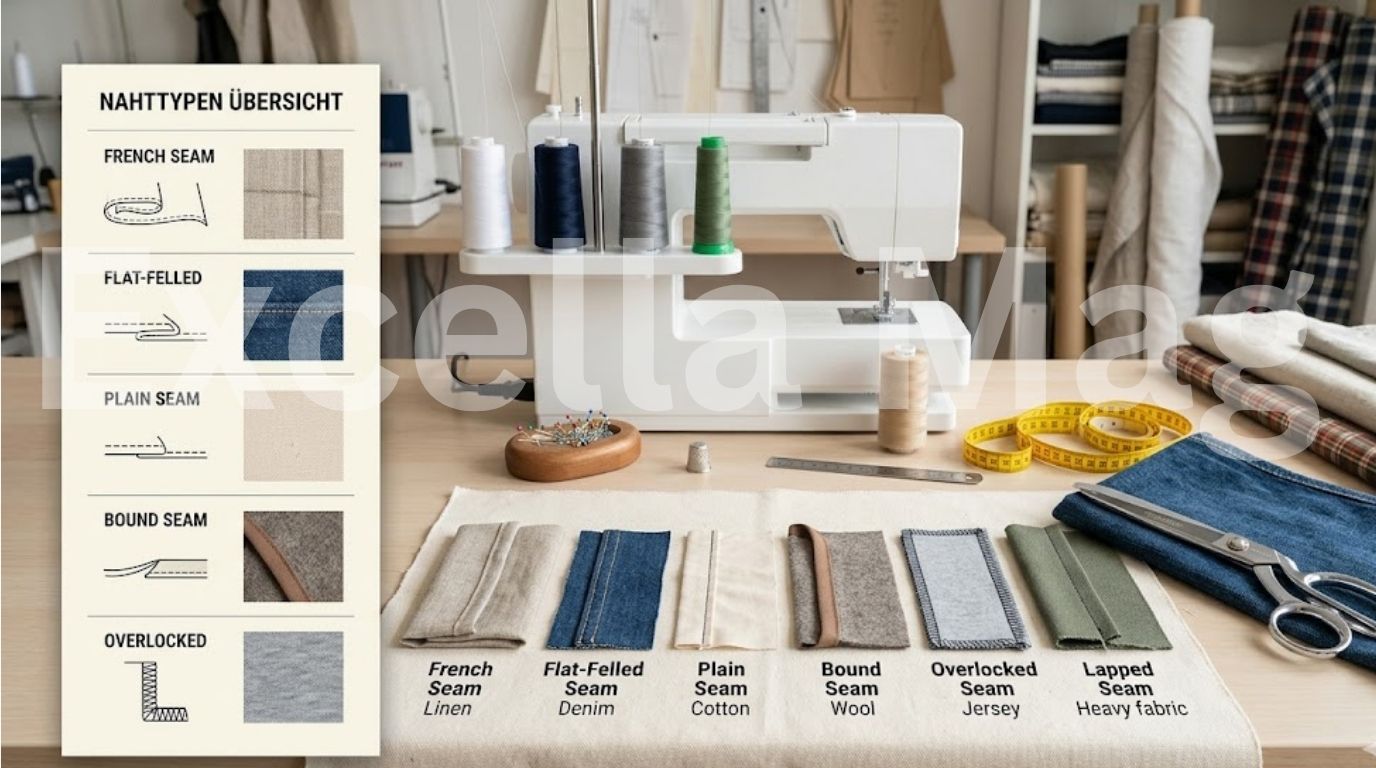
Pick up any finished garment — a pair of well-worn jeans, a silk blouse, a child’s school shirt — and turn it inside out. What you find there tells you almost everything about the quality of the piece. Those thin lines of thread holding everything together are not incidental; they are engineering decisions. Every single one of them is a Nahttyp — a seam type — and choosing the right one for the right fabric in the right situation is one of the most underrated skills in all of sewing.
The word Nahttypen comes from German: Naht meaning seam, and Typen meaning types. While the term itself is German in origin, the concept it represents is universal across every sewing room, atelier, and textile factory on earth. Whether you are a complete beginner working through your first cotton project or an experienced tailor finishing a client’s formal suit, the question of which seam type to use never fully goes away — and the answer genuinely matters.
Most beginner guides stop at telling you that a plain seam exists, and most advanced guides assume you already know the basics. This article sits in between: a complete, honest, practical chart and guide to every major Nahttyp, when it truly earns its place, and exactly how to execute it. No unnecessary jargon, no vague advice. Just real, tested, useful information that will make your sewing better immediately.
“The seam is invisible when it works perfectly. It only announces itself when something has gone wrong.”
What Are Nahttypen, Really?
In the most literal sense, a Nahttyp is simply the method by which two or more pieces of fabric are joined together using thread. But that definition sells the concept short. A seam type determines how a garment behaves under stress, how it looks from both inside and outside, how it feels against skin, how it survives repeated washing, and even how easily it can be altered later. These are not minor details — they are the structural DNA of any sewn item.
Different Nahttypen have evolved over centuries of practical necessity. Textile construction has been documented since ancient civilizations, and even then, craftspeople were experimenting with different ways to join fabric. The flat-felled seam, which we associate today with denim workwear, has its roots in sailmaking, where a weak seam could quite literally sink a ship. The French seam, beloved in couture houses, was developed precisely to solve the problem of fraying raw edges on expensive lightweight fabrics without adding bulk or unsightly finishing tape.
Understanding Nahttypen is not about memorizing a list. It is about developing a kind of intuition — the ability to look at a fabric, consider a garment’s purpose, and immediately know which seam construction will serve it best. That intuition comes from understanding why each seam type was invented in the first place, and that is exactly what this guide is designed to build.
The Complete Nahttypen Chart at a Glance
Before diving into each seam type in detail, here is a complete reference chart you can bookmark and return to. The difficulty ratings reflect the learning curve for a careful beginner with a standard home sewing machine.
| Seam Type | Best Fabric | Main Use | Difficulty |
|---|---|---|---|
| Plain Seam (Einfachnaht) | Cotton, linen, medium-weight | General garment construction | Beginner |
| French Seam (Fransösische Naht) | Silk, chiffon, sheer fabrics | Blouses, lingerie, luxury garments | Intermediate |
| Flat-Felled Seam (Flachnaht) | Denim, canvas, heavy cotton | Jeans, workwear, outerwear | Intermediate |
| Overlock / Serged Seam | Knit fabrics, jersey, stretch | T-shirts, sportswear, activewear | Beginner |
| Bound Seam (Versäuberte Naht) | Unlined jackets, heavy woven | Tailoring, couture finishing | Advanced |
| Welt Seam (Paspelung) | Wool, suiting, medium-heavy | Tailored coats, formal jackets | Advanced |
| Zigzag Seam | Stretch, knit, jersey | Budget alternative to overlock | Beginner |
| Lapped Seam (Überlappungsnaht) | Leather, suede, felt, vinyl | Bag-making, upholstery | Intermediate |
| Hong Kong Seam | Lined and unlined wovens | Unlined blazers, couture interiors | Intermediate |
| Piped / Decorative Seam | Home décor, garment accents | Cushions, structured bags, lapels | Advanced |
The Plain Seam — Where Every Sewer Begins
The plain seam, or Einfachnaht in German, is the workhorse of the sewing world. Place two pieces of fabric right sides together, align the raw edges, and stitch a straight line at your chosen seam allowance — typically 1.5 cm in European patterns or 5/8 inch in American patterns. Press the seam open or to one side, and you have the foundation of virtually every sewn garment ever made.
What makes the plain seam both its greatest strength and its Achilles heel is its simplicity. Because the raw edges are left exposed inside the garment, the plain seam requires finishing — usually with a zigzag stitch, overlocker, or bias tape — to prevent fraying over time. Skip that finishing step on a woven fabric and you will find, after a dozen washes, that the seam allowances have gradually unravelled into a fuzzy mess.
The key to a beautiful plain seam is consistency. Inconsistent seam allowances cause garments to be too large or too small, and the silhouette suffers instantly. Use the guide lines etched into your machine’s needle plate, and invest in a seam guide if you find yourself drifting. Another overlooked detail: always backstitch or lockstitch at both ends of every plain seam, or the entire seam will unravel from the ends within weeks of wear.
Pro Tip: When sewing a plain seam on a slippery fabric like polyester lining, place a strip of tissue paper under the fabric before stitching. Tear it away afterward — it prevents the fabric from being dragged into the feed dogs and produces a clean, even result.
The French Seam — Elegance You Can’t See
If you have ever turned a high-end silk blouse inside out and marvelled at how clean and enclosed all the interior seams are — with no raw edges visible anywhere — you were almost certainly looking at French seams. The French seam, or Fransösische Naht, is built in two passes: first you sew the fabric wrong sides together, trim the seam allowance close, then fold the fabric so right sides are together and stitch again, enclosing the first seam entirely inside a fabric tube.
The result is a seam that is simultaneously the strongest option for delicate fabrics and the most beautiful from an interior finishing perspective. Because there are no exposed raw edges at all, fraying is completely impossible. This makes the French seam the obvious choice for sheer fabrics like chiffon, organza, or voile, where the interior of the garment is partially visible from the outside when light passes through. It also performs brilliantly on fine cotton lawn and silk charmeuse, where any interior bulk would disrupt the soft drape.
The common mistake when attempting French seams for the first time is leaving too much seam allowance on the first pass. Trim aggressively — to about 3mm — before flipping the fabric. If you don’t, the enclosed seam allowance creates a lumpy ridge inside the finished seam that is both unsightly and uncomfortable against the skin.
The Flat-Felled Seam — Strength You Can See and Feel
Run your fingers along the outside leg seam of a pair of quality jeans. You will feel two parallel rows of stitching on the outside, and inside, the seam allowances are folded, overlapped, and stitched flat. That is a flat-felled seam, and it is one of the most mechanically impressive seam constructions in everyday clothing. It is so strong that it was historically used in sailcloth, military uniforms, and survival gear — anywhere that seam failure would have serious consequences.
Sewing a flat-felled seam requires patience and precision. You begin with wrong sides together — the opposite of most seam types — stitch your seam, press one seam allowance to one side, trim the under allowance to about 6mm, fold the upper allowance over it, press flat, and topstitch close to the folded edge. Every pressing step is non-negotiable; without it, the overlapping allowances shift and the topstitching wanders.
Because it is visible from the outside, the flat-felled seam is also a design element. The thread colour you choose for topstitching communicates something about the garment’s personality — matching thread gives a refined, understated look, while contrasting thread gives a bold, workwear-authentic feel. This is one of the few Nahttypen where the functional and decorative dimensions are genuinely inseparable.
The Overlock Seam — The Modern Workhorse for Knits
Anyone who has ever tried to sew a T-shirt on a standard sewing machine and ended up with a seam that pops when stretched knows the fundamental problem: straight stitches do not stretch. Woven fabrics accommodate the seam allowance’s rigidity because the surrounding fabric doesn’t stretch much either. But knit fabrics — jersey, interlock, ribbing, ponte — move, stretch, and recover constantly, and a seam that doesn’t move with them will simply snap under tension.
The overlock seam, produced by a serger, solves this in one elegant pass: it trims the seam allowance, encloses the raw edges with looper threads, and stitches a stretchy chain stitch simultaneously. The result is a seam that stretches with the fabric, has no raw edges to fray, and produces the clean finish you see inside any retail knit garment. The ISO standards for textile construction recognize overlock seams as the industry baseline for knit garment production.
If you do not own a serger, a narrow zigzag stitch on a regular machine is a workable substitute. Keep the stitch width around 2.5–3mm to give genuine stretch, and the stitch length short at around 2mm to prevent the seam from popping under stress. A lightning bolt stitch, if your machine has one, is even better than a plain zigzag for stretch seams.
The Bound Seam and Hong Kong Finish — When Interiors Matter
There is a category of garment — the unlined blazer, the tailored jacket worn open, the structured coat — where the interior is partially visible whenever the garment is worn open. In these pieces, raw seam allowances finished with a quick zigzag look cheap and careless. They break the illusion of quality that the exterior is working so hard to create. This is where bound seams and the Hong Kong finish earn their reputation.
A bound seam wraps the raw edge of each seam allowance in a strip of fabric — traditionally bias-cut silk or matching cotton — so that the interior of the garment looks as considered and refined as the exterior. It requires more time and material than any other finishing method, which is exactly why it is associated with couture and high-end tailoring.
The Hong Kong finish is a simpler variation: a narrow strip of bias-cut fabric is wrapped around each raw edge individually and stitched down. It is significantly faster and still produces an interior that looks intentional and professional. For home sewers making unlined jackets, this is often the most realistic path to a beautiful interior finish without industrial equipment or hours of additional work.
Specialty Nahttypen: Lapped, Welt, and Piped Seams
The Lapped Seam for Non-Fray Materials
Leather, suede, felt, vinyl, and other non-woven materials present a unique sewing challenge: they cannot be pressed open easily, they show pin holes permanently, and their raw edges do not fray at all. The lapped seam is designed for exactly these materials. Rather than placing pieces right sides together and stitching a conventional seam, you overlap one piece on top of the other and topstitch through both layers. The result is flat, strong, and completely appropriate for materials where conventional seam constructions would look awkward or cause permanent damage.
The Welt Seam for Tailored Structure
The welt seam is a variation of the plain seam where one or both seam allowances are pressed to one side and topstitched down, creating a raised ridge — the welt — on the outside of the garment. It adds both structure and visual interest, and is particularly common in tailored outerwear and structured trousers. The topstitching line is visible and decorative, so thread choice and stitching precision matter considerably. A wandering topstitch line on a welt seam is immediately obvious and difficult to fix without unpicking from scratch.
The Piped Seam for Decorative Impact
Piped seams introduce a third fabric element — a narrow tube of fabric, usually cut on the bias and enclosing a cord — into the seam itself. The piping sits at the seam line and creates a raised, defined edge that adds structure, contrast, and a deliberately decorative quality. It is most common in upholstery, structured bags, and garment details like lapels or yoke edges. Getting piped seams right requires a piping foot and careful clipping around curves, but the result, when executed well, is genuinely striking.
How to Choose the Right Nahttyp for Your Project
The single most important factor in choosing a Nahttyp is fabric type. Delicate, sheer, or lightweight fabrics need enclosed seams that prevent fraying without adding bulk — French seams are almost always the right answer. Heavy fabrics need structural seams that can handle stress and lay flat — flat-felled or welt seams are your options. Stretch fabrics need flexible seams — overlock or zigzag constructions are essential. Non-fray materials like leather need surface-applied seams — lapped constructions make immediate sense.
The second factor is visibility. Will the interior of this garment ever be seen? An unlined jacket demands either a bound seam or a Hong Kong finish. A lined jacket can get away with a plain seam because the lining covers everything. A sheer blouse essentially requires a French seam because the interior is always partially visible.
The third factor — often underestimated — is your skill level and your tools. A serger produces overlock seams efficiently; a standard machine requires a zigzag workaround. Flat-felled seams require careful pressing at multiple stages; if you are sewing quickly without an iron nearby, they will turn out badly. Choose seam types that match both your current skill level and your actual working conditions.
Quick Decision Guide: Silk or sheer → French seam. Denim or canvas → Flat-felled seam. Jersey or knit → Overlock or zigzag. Leather or felt → Lapped seam. Unlined tailored jacket → Hong Kong finish. Everything else → Plain seam with finishing.
Common Nahttypen Mistakes and How to Avoid Them
The most common mistake across all seam types is inconsistent seam allowance. If your pattern calls for 1.5 cm and you vary between 1 cm and 2 cm throughout, the finished piece will not fit correctly — side seams will curve, armholes will be too small, bodices will be too wide. Use your machine’s needle plate guides religiously, or apply masking tape to the machine bed as a seam guide.
The second major mistake is skipping pressing. Every seam type requires pressing at some stage. Sewers who skip pressing produce garments that look homemade in the negative sense — puffy, uneven, structurally weak. A steam iron is not optional equipment; it is half the sewing process.
Third is using the wrong needle for the fabric. A universal needle on fine silk will cause skipped stitches and fabric damage. A standard needle on knit fabric will create holes and cause runs. A leather needle on woven fabric creates unnecessarily large holes. Match your needle type to your fabric every single time: ballpoint for knits, sharp for wovens, wedge-point for leather, and fine (70/10 or 60/8) for delicate sheers.
Conclusion
Mastering Nahttypen is what separates a good sewer from a great one. Every seam type exists for a reason — the right choice protects your fabric, strengthens your garment, and elevates the final result from homemade to professional. Start with the basics, practice consistently, and let your seam choices become instinct. Because great sewing is not just what people see — it is what holds everything together when nobody is looking.
Frequently Asked Questions About Nahttypen
What does Nahttypen mean in English? It is a German word that translates directly to “seam types” — the different methods used to join fabric pieces together in sewing.
Which Nahttyp is best for beginners to learn first? The plain seam (Einfachnaht) — it is the most versatile, requires no special equipment, and is the foundation all other seams are built on.
Can I sew a French seam on a standard sewing machine? Yes — French seams are sewn entirely on a standard machine with a straight stitch; no special attachments needed, just careful pressing between the two passes.
Why do jeans use flat-felled seams instead of plain seams? Flat-felled seams are significantly stronger because the allowances are enclosed and stitched down, withstanding the extreme stress denim workwear faces daily.
Do I need a serger to sew knit fabrics properly? A serger gives the best results, but a narrow zigzag on a standard machine is a workable alternative for most home sewing projects.
What is the difference between a bound seam and a Hong Kong finish? A bound seam encloses the entire seam allowance for a sculptural finish; a Hong Kong finish wraps just the raw edge of each allowance separately — both look beautiful, but Hong Kong is faster.
Which seam type should I use for leather or faux leather? A lapped seam — it avoids pressing problems, leaves no pin holes, and produces a flat, strong result appropriate for non-fray materials.
How does choosing the wrong Nahttyp affect a finished garment? It can cause fraying, poor fit, discomfort, visible puckering, seam failure under stress, or an unprofessional interior — all affecting durability and appearance.
Is pressing between sewing steps really necessary? Absolutely — pressing sets stitches, flattens seam allowances, and is the single biggest factor separating a polished result from a homemade-looking one.
Read More: Brasssmile com Fashion Review: Is This Online Style Platform Worth Your Time?

